
One of the things I appreciate about the ancient Greeks is that they had multiple words for love. It seems wrong to use the same word for “I love chocolate” and “I love my spouse/partner/pet/living companion.” Even among people, it feels like a different experience to “love” a spouse/partner and to “love” a child.
But the Greeks used different words to distinguish between these different types of love. People today disagree about exactly how many words there were, but these six words are kind of a common midpoint:
Agape literally means “affection,” but is usually considered to be universal and/or unconditional love. It tends to be used in a spiritual or religious way. Certainly Christianity and most Western religions describe this as the kind of love that God or Spirit has for human beings, and what people attempt to emulate in their love for the Divine.
Eros means a love that includes sexual passion and/or a strong appreciation of the beauty of the individual. It is considered to be a more intimate form of love…the kind of love that is more usually associated with Valentine’s Day, at least between adults.
Philia is used for an affection between equals based on familiarity, high regard, community, and virtue. This is the term for a deep friendship between equals who appreciate each other and share a high level of trust and loyalty. This is the root of the name of Philadelphia, the City of Brotherly Love.
Xenia is the basis for the ancient Greek concept of hospitality. Back then, when there wasn’t a McDonald’s or a Holiday Inn in every town, travelers had to rely on the kindness of strangers for food and lodging. So Xenia was kind of a transactional friendship in which residents would treat strangers as friends, at least in terms of providing some meals and protection from the elements. There were rituals on both sides, and definite limits in terms of how much travelers could expect from their hosts. But it was a ritualized code of conduct that allowed diverse people to get along.
Philautia means love of self. It is the proper amount of attention to one’s own happiness and well-being without falling into excessive selfishness or narcissism. The Greeks believed people needed self-love in order to build others forms of healthy love. It is similar to what we mean by a healthy level of self-esteem.
Storge is love and affection, particularly associated with the love between parents and children. It was expanded to include all familial love, such as between children and grandparents, aunts and uncles, cousins, etc.
Perhaps not so much by the Greeks, but Storge got extended to the relationship between the governers and the governed. Certainly many Europrean monarchies were based on the idea that royalty were higher or better people than the common folk, and it was their duty and privilege to run things for the people, just as parents take care of children. In return, the rulers were loved and honored by their subjects, just as children love their parents.
But in my opinion, that is the reverse in a democracy like ours (OK, really a republic, but won’t get into that now). In our system, it is the people who are supposed to be the ones in power. The elected officials, on the other hand, are dependent on our votes for their job. We show our Storge love to our country, embodied by our leadership, by giving them our campaign contributions, our endorsements, our opinions about how they should address issues, and our votes. They, in return, should provide public services to all of the people, not just the ones who gave them money or votes. They, as the humans incarnating as the country to which all the people belong, should act in accordance with the highest good for the majority of the people. Ideally, it would be an exchange of love: love by the people for their country, represented by those they have freely chosen for their leaders, and love by the leaders for the people that they serve.
But who is feeling the love right now? Or maybe love is expecting too much. But who even seems happy? It just seems like everyone feels stressed and attacked and misunderstood so that our civic engagement feels like war, not like love of our country and our neighbors.
Forget about the directly political arena. Let’s talk about communal events that generally bring all Americans together.
Another facet of ancient Greek culture were area-wide athletic competitions, which was the inspiration for our current day Olympics. I’m not a big sports fan, but I had a soft spot in my heart for the Olympics. It was a great way for the finest athletes across the world to compete in ways other than economic dominance or military conflict.
But look at this year’s Olympics. Vice President Vance got publically booed when he arrived to head up the US Olympians. When asked about representing the US, several competitors have admitted a bit of mixed feelings because they didn’t endorse everything that was going on in our country right now. They have been excoriated on TV and received tons of hate mail and even some death threats on social media. One white female skier was attacked for saying she wanted to represent the values of inclusivity, diversity, and kindness at the Games and quoting Nelson Mandala about peace. Then, of course, there is the charming photograph of a message one non-US Olympian wrote in the snow with his urine expressing his opposition to ICE.
Not exactly the feel-good vibes of past Olympics.
Or let’s talk about the Super Bowl. I don’t follow football, so the only reason I care about the Super Bowl, other than if one of my brothers’ teams are playing, is because our spiritual center has a Chili Cook-Off and Watch Party. I’m not really into the commercials or even the half time show most of the time, so I’ll sometimes come eat some chili and leave during the second quarter. But I did want to see the half time show by Big Bunny.
I found it lively and uplifting with an infectious spirit and energy. It had singing and dancing and color and flags and children and even a real wedding! While it focused on Puerto Rican history and culture, I loved the ending when there was a shout out to all the countries in the Americas, including our neighbor to the North, Canada. I thought it was wonderful.
But apparently many of my fellow Americans did not. I saw a video in which Big Bunny said that in the aftermath of the Superbowl, he received so many messages of criticism and hated and even numerous death threats that he had to get off of social media. He said, “I’m strong, but I’m not made of steel.”
And I’m just like, “Really? It was a 15 minute performance by one of the most popular musicians on the planet right now. But people don’t have better ways to spend their time than to send messages of hatred and threats of violence? Just because he sang in Spanish? Because he focused on Puerto Rico, which technically part of the United States?”
But of course, I realize that they are just following in the footsteps of our President, who says terrible, insulting, demeaning, and threatening things about anyone who disagrees with him or any community in the country that didn’t vote for him. While this was not the most serious insult or threat by a long shot, I personally was most shocked when the night after the October 2025 No Kings protests (the largest single-day protest in American history), the President posted an AI video of himself flying a plane to the theme song from Top Gun and dumping excrement on the 7 million Americans who exercised their Constituional rights to express themselves and to petition their government when they believe it has gone astray.
Which is just to say, as Lady Gaga (who participated in the Bad Bunny half time show) sings, that our country currently is in a “Bad Romance.”
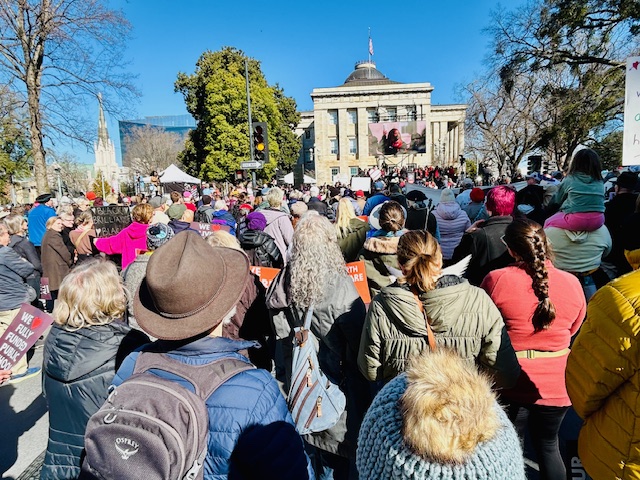
That is why the Mass People’s Assembly, organized by Repairers of the Breach and led by Rev. William Barber, was the greatest Valetine’s Day gift I could have possibly gotten. The theme of the event, which was held on Valentine’s Day in downtown Raleigh, was “Love Forward Together.” Following in the oral tradition of Rev. Dr. Martin Luther King Jr., Rev Barber’s messages were focused on the transformative power of love. And mirroring the work of minister and civil rights activist Rev. Jesse Jackson, who died today, that love was extended to what Rev. Jackson called “The Rainbow Coalition”: people of every race, every religion, every gender identification, every sexual orientation, every age, every level of wealth, every physical location, every status of bodily health, and every other classification by which we distinguish ourselves from others.
Plus, this was the best organized rally I’ve been to during these Trump-era protests. Rev. Barber knows what he is doing, spiritually, politically, and logistically.
I can’t begin to describe in words the inspiration from this gathering. But here is a video of him describing the event, including the 3 day walk from Wilson to Raleigh to arrive at the rally:
One thing that I really liked was that he said in these protests, we should stop talking about the things we don’t like and focus on what we want to see in the world. Let’s not focus on the negative and the hatred. He asked us instead what do we love enough to fight for. In fact, they asked us in advance to bring signs about what we loved. That was hard for me because there are so many things I love. In the end, I went with a quote that is more about the system than any one person/thing/cause:
Power at its best is love implementing the demands of justice, and justice at its best is power correcting everything that stands against love.
—-Rev. Dr. Martin Luther King Jr., 1967
I love that quote because it combines love with both power and justice. I believe all three of those need to be working in concert to create the “Beloved Community” that Dr. King talked about.
The bottom line for me is that I believe we need to return to a Storge relationship with our government and our country–even, or maybe even especially, with those people on the “other” side. I grew up in the Washington DC area, so I’m used to political disagreements. But I am not used to being hated or insulted or feeling threatened because of those disagreements. It’s taken me a long time, but more and more I believe that only love can restore the democracy we once had…the one I took for granted. So personally, I’m trying to anchor my political advocacy in love.
Who is with me? Please respond in the comments below.
I will close with a talk with another inspiring speaker from the rally who spoke about the power of love:
 blissfullu.com
4 thoughts on “A Storge Valentine’s Day”