
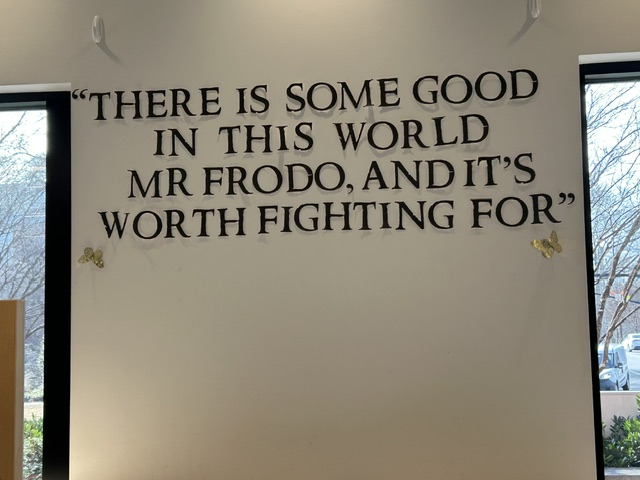
This quote adorns the wall in the YA section of the Cary Regional Library. As much as I go to that library–usually weekly–I’m still inspired by it every time. It’s from the movie version of The Two Towers, the second movie in the Peter Jackson’s adaption of J.R.R. Tolkien’s Lord of the Rings series. It’s a shorter, punchier version of a speech Samwise Gamgee gives in the book, basically saying that the great stories are about heroes who fought on way beyond anything they thought they were capable of. They fought on because they cared enough about something they were fighting for, something they just couldn’t give up on.
Increasingly, Memorial Day has become the unofficial kickoff to summer. So Memorial Day is about pools opening and first trips to the beach and cookouts and concerts and such. And all of that is great…I’m not saying I don’t participagte in such rituals myself. But I try not to let all the festivities eclipse the real meaning of the holiday, which is the millions of people who have died in military service, fighting to protect American values.
Other than a few testosterone-driven young men, I don’t think anyone really wants to go to war. I’m a great believer in the principles of nonviolent protest advocated by such people as Mahatma Gandhi, Nelson Mandela, the Dalai Llama, and Dr. Martin Luther King. But are there times when war is necessary? Would it have been possible to have formed this new country, this new new form of government in a new world, without going to war? Is war justified to put an end to such morally abhorent practices as slavary in the United States or the concentration camps and Jewish holocaust of the Nazis?
We’ve been having a fascinating series of talks this month on the topic of Divine Doubt. The premise is that we may think that having faith and having doubts are opposites. But we don’t believe that in our spiritual tradition. I personally wonder whether blind, unquestioning trust in ancient spiritual texts or in religious authorities is actually faith at all. Is parroting what you’ve been told without considering whether or not you really think is true being faithful? Or is it just escaping responsibility for your moral actions by being a follower and avoiding grappling with hard issues, like is a war ever morally justified?
There is a bumper sticker popular among many Christians that drives me CRAZY. It says “God said it, I believe it, That settles it.” (Sometimes they leave out the middle, arguing that it doesn’t matter if you believe it or not, you just do it.) Really? God spoke directly to you? Or at least can you read Hebrew, Aramaic, and Greek so you may interpret the word of God for yourself?
My beliefs are antithetical to that. I think having faith is studying different beliefs yourself, wrestling with the different versions of Spirit and spiritual practices, and deciding which ones you choose to believe and act upon and which ones you don’t speak to you. I try to be respectful and nonjudgmental towards all spiritual paths, as long as they aren’t forcing that path on people who don’t want it.
Now, do I succeed in being nonjudgemental all the time? Not even close. I have faith in the principle of Spirit being unconditional love and therefore we should love each other all the time. Do I always follow that practice? No, I don’t. I’ve come a long way from my earlier years when I believed that judging and rejecting others with different spiritual ideas and political policies was morally incumbent upon me. But I have come to embrace the notion that Dr. King including in his sermon of Loving Your Enemies that “We shall never be true children of our heavenly Father until we love our enemies and pray for those who persecute us.” That is, I embrace it intellectually. I live it almost never. But I try to do the best I can in practicing it. I do believe that everyone comes from and returns to the same spiritual source, which is Unconditational Love. So I try to see that Unconditional Love IN everyone and feel love in my heart for everyone.
But I find it hard to do consistently.
I really can’t understand why President Trump and his party thought it was important to give billionaires who are making thousands of dollars PER MINUTE a tax cut. I mean, how many billions of dollars does one person or one family need? And in order to pay for those tax cuts, they reduced funds that provide medical care and food programs for the poor? I just can’t wrap my head around why they thought that is a good or necessary idea. And yet, I’m trying to love them although their actions seem very unloving towards people who don’t have much money.
In Loving Your Enemies, Dr. King argues that we need to love those who disagree with us, for our own sake as well as their’s, but fight the system that is unjust, unfair, unloving. So that’s what I’m trying to do. But it gets exhausting. I haven’t written a blog post in weeks because I’ve been teaching all the time and when I’m not, my time is spent in taking care of myself and my family, activing supporting my spiritual center, and fighting to defend our democracy, which I think is under great assault right now.
Of course, I’m not fighting literally. However, it makes me feel even more respect and love for those who have been physically, mentally, and emotionally injured or killed in service to our country. So my heart is full of love and gratitude for those who we are supposed to remember today. I also feel that I honor their sacrifice by engaging in intense nonviolent civic and political engagement to protect those American values that I think they died for. And I need to do that every day, not just on Memorial Day.
I’ll end with the full passage from the movie of The Two Towers that includes that quote. It may not be by Tolkien himself, but as he was a lieutenant in the British Forces during the War that was supposed to end all wars, the sentiment is reflected in many of his writings.
Frodo Baggins: I can not do this, Sam.
Samwise Gamgee: I know. It’s all wrong. By rights we should not even be here. But we are. It’s like in the great stories, Mr. Frodo. The ones that really mattered. Full of darkness and danger, They Were. And Sometimes you did not want to know the end. Because How Could the end be happy? How Could the world go back to the way it was when so much bad had happened? But in the end, it’s only a passing thing, This shadow. Even darkness must pass. A new day will come. And When the sun shines it will shine out the clearer. Those were the stories that stayed with you. That meant something, even if you were too small to understand why. But I think, Mr. Frodo, I do understand. I know now. Folk In Those stories had lots of chances of turning back, only They Did not. They kept going. Because They Were holding on to something.
Frodo Baggins: What are we holding on to, Sam?
Samwise Gamgee: That there’s some good in this world, Mr. Frodo … and it’s worth fighting for.

