
One of the columnists in one of the newspapers I read wrote today that this Juneteenth felt hollow. To him, it seems that true freedom and equality between black and white people in the US seems farther away than it did in 2021 when Congress made ““Juneteenth National Independence Day” a federal holiday. I totally get how that journalist, who is African American, can feel that way. But this has actually been a pretty inspiring holiday for me.
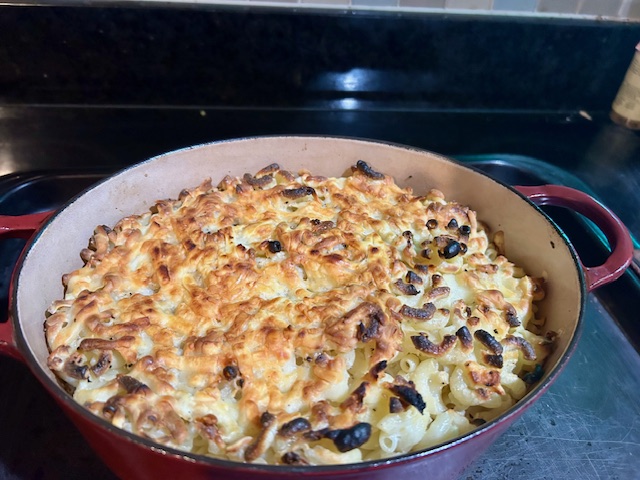
I first celebrated Juneteenth in 2020 with red beans and rice. The next year, I made a chicken barbecue. But in 2022, I started my current tradition of a whole new way (for me) of making macaroni and cheese. Originally called Macaroni Pie, it comes from a recipe attributed to James Hemmings. I learned about this from a wonderful series called High on the Hog, which traced the influences on American cooking from the African American culture.
James Hemmings was an enslaved man serving Thomas Jefferson as his cook. Jefferson took him to France when Jefferson was the Ambassador to that country, and Hemmings studied cooking with French chefs. When he and Jefferson returned to the US, he continued to cook dishes he had learned abroad. The TV show suggested that James Hemmings was the one who introduced Macaroni Pie to the US. (For more details, see my post: https://blissfullu.com/2022/06/21/meatless-monday-juneteenth-edition-or-lessons-from-african-american-cooking/)
So James Hemmings is my first James.
My second James is James–a novel by Percival Everett that reimagines the book of The Adventures of Huckleberry Finn from the perspective of a much more sophisticated version of Jim, the runaway slave. (For more details, see my post from yesterday: https://blissfullu.com/2025/06/18/the-books-of-summer/).
So far, I’m loving it. I stayed up too late last night reading it, and stayed in bed too long this morning reading more. I justified it as what better way to acknowledge Juneteenth than to read the story of a man trying to escape his enslaved life. Which is true, but it’s also true that I couldn’t wait to find out how the entire tale would unfold. I eventually got up and got to work, but I’m sure I will finish it tonight.
While I enjoy reading the book, it also provoked some questions for me about me. I’ve read Huckleberry Finn multiple times, and I’ve taught it in a high school American Literature class at least three times. But never have I thought much about Jim’s perspective on the events. I’m afraid that is one example of my white privilege. That’s part of why I really enjoy this book, because it is helping me to imagine the entire story, and the enslaved people’s experience in general, through the eyes of the oppressed. Obviously, I’ve never been in favor of enslaving people. But because some of my ancestors settled in the South before the Revolution, I’m sure they did. It doesn’t excite me to acknowledge that, but it feels significant to do so on Juneteenth.
So then I got to thinking… If James Hemmings learned about Macaroni Pie in France, then the recipe came from white people’s culture. But what if he doesn’t want to be famous for a white people’s dish? Then, as I looked into it more, it turns out that Montecello is no longer suggesting he introduced the recipe to the United States. Apparently, they had been serving it in New England since the later 1600s.
OK, so now we can’t say James Hemmings “introduced” or “invented” macaroni and cheese. But undoubtedly, he helped to popularize it, especially in the South. It is one of the dishes most African American’s include in their list of “soul food,” so it made the leap from white to black cuisine somehow. But I haven’t found a specific link about how that happened.
I began to think perhaps I should have something that was more connected to African cuisine for my Juneteenth dinner. But that had its challenges. I’m allergic to nuts, okra, bananas, tamarind, and watermelon. I don’t really like collards or yams/sweet potatoes. I try not to eat fried foods or beef. So lots of the major traditional ingredients and recipes of African American soul food are just not a good match for me.
Then I had an AH-HA moment.
At the Cary Downtown Farmers Market, there is a woman who was originally from Ghana who sells traditional African sauces and spices, along with some baskets and other African goods. What if I made a side dish using her sauce to represent African cuisine and made Hennings’ Macaroni Pie as the source of a favorite African American food?
Here is her sauce:

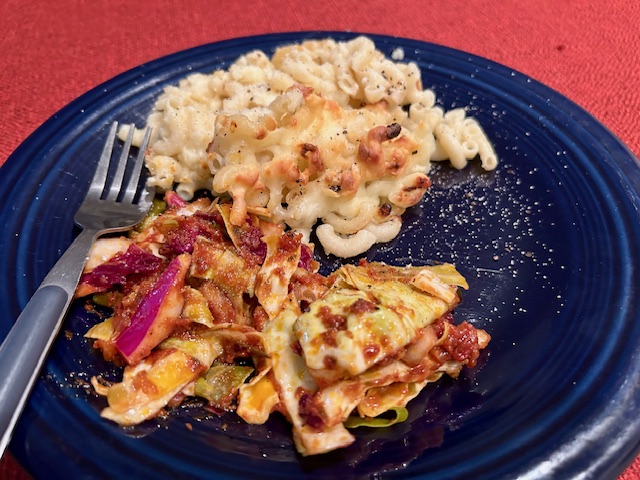
I’ve made it before with cooked cabbage and onions, but I know my son prefers raw vegetables. So I used the sauce to make a kind of African coleslaw.

And served it with my “traditional” Hemmings Macaroni Pie:
The two went together really well:
And I felt it was a good compromise, given the lack of records or acknowledgment of the contributions of enslaved people to our current eating preferences.
One final thing that today has sparked in me. I understand the feelings of the author I started this post discussing. I agree that this Administration has been totally backsliding on the rights and recognition, not only of African Americans, but pretty much everyone besides straight White Christians, particularly males. And that is a bummer. I can see why people don’t find reason to celebrate today.
But reading James has reminded me how truly horrific things were for enslaved people. As much as I don’t like most of what is going on politically right now, it’s still light years ahead of the experience of Huckleberry Finn’s Jim and the other enslaved people in 1860. That’s not an excuse for complacency. But for me, it is a reminder that our country has faced up to worse behavior in the past and refused to allow it to continue. That gives me hope that we will do that again. It’s not the general direction we’re heading in right now. But I choose to believe that like our ancestors, we will realize our mistakes and start treating people more humanely once again.
One of my favorite quotes is attributed to Dr. Martin Luther King Jr, who included it in one of speeches. However, he put it in quotation marks because he was quoting someone, probably Unitarian Minister, prominent American Transcendentalist, and abolitionist Theodore Parker (King didn’t include a citation). That quote is:
The arc of the moral universe is long, but it bends toward justice.
James reminds me of that this Juneteenth. We may indeed be backsliding this year, or maybe this entire Presidency. But I remain focused on knowing we’ve gotten better than our past, but it wasn’t quick or easy. I may be eating and reading today, but I’m committed to continuing the campaign to make this a country with greater freedom and equality for all.
But for tonight, let me go finish James.
 blissfullu.com