

Last night I had a very special opportunity to celebrate the Islamic spiritual practice of Ramadan, even though I am not Muslim. Ramadan is one of the most sacred traditions in Islam. It commemorates the revelation of the Qur’an through a month in which Muslims shift their focus from their material world to their spiritual renewal. While there are many aspects to this practice, one of the best known is that Muslims refrain from eating and drinking from dawn until sunset.
Once the sun has officially set, Muslims share a meal that is even more appreciated because of their fast. It is a community meal in which they feed their bonds with each other in addition to feeding their physical bodies.
Earlier this month, I wrote about how on the first day of Ramadan this year, I fasted and then fixed a traditional “breaking the feast” meal (click here to read that post). I try to celebrate as many holidays as possible (although Ramadan isn’t really a holiday until the celebrations around ending their fasting on Eid al Fitr). With all of the destruction and warfare going on in Gaza and with the current adminstration’s general negativity towards Muslims, I felt fasting on the first day of Ramadan was my way to support the Islamic community, at least on a spiritual level.
However, Ramadan isn’t really supposed to be an individual activity. It’s about building community as well and renewing our spiritual practices. Which is why I was so happy when our spiritual community received this invitation to an Interfaith Ramadan Friendship meal:

The Divan Center is a cultural nonprofit affiliated with the Turkish-based Hizmet (“Service” in English) movement. Started in the 1970’s, Hizmet “advocates for the ideals of human rights, equal opportunity, democracy, non-violence and the emphatic acceptance of religious and cultural diversity.”
The Divan Center says this in their purpose statement:
At Divan, we consider dialogue as a key philosophy to settle differences and move forward as a community. To achieve this ideal, Divan Center organizes and promotes activities including diversity awareness seminars, cultural festivals, dialogue dinners, community service, art performances, and cultural trips where people from different backgrounds can meet and find common ground. Everyone is welcome at Divan!
Turkey is a predominantly Muslim country, but does have populations of other faiths as well. Similarly, the membership of the Divan Center appears to be predominantly Muslim. However, they are actively engaged in developing programs, including this Friendship Dinner, to connect with people of any religion or no religion.
I’m always up for an interfaith experience. Regular readers of this blog also know that I’m a great believer in food ministry. Plus, in the universe’s synchronicity, the main book I’m reading right now is Alton Brown’s collection of essays entitled Food for Thought. In his essay “Hunt and Gather,” Brown states that the major meanings of food are nourishment (we have to eat to live), identity (so much of who we are is based on the food we choose to eat), and connectivity (food gathers people together). Brown goes on to discuss the ancient Greek virtue they called “philoxenia,” usually translated as hospitality. He explains the term this way:
Philoxenia means to graciously offer what is yours to a stranger, and to graciously accept what is offered to you by strangers….In the Muslim tradition, hospitality demands that comfort in the form of food and drink, and even a bath, must be offered before one question is asked of the guest. Philoxenia places expectations onthe guy as well, such as graciously accepting what is offered…Life is more complex today, but offering what you have to a stranger, or even simply sharing the experience of breaking bread with a stranger, can still be a spiritual event of considerable power. (pp. 102-103)
That truly describes what last night’s experience was at the Divan Center. It was not just a meal; it was a banquet of love and connection and acceptance among people who were different and who didn’t know each other, but were building bridges through breaking bread. It was finding unity among diversity brought together by food.
So we settled around round tables and got to know each while we awaited the sundown when we could break our fast. While there was no expectation that non-Muslims needed to fast, I decided that would be a good practice of philoxenia as their guest. However, I only refrained from eating food; I continued to drink liquids, which the Muslim fast does not allow. But I didn’t drink anything I thought fell into the category of “food,” like a smoothie a bottle of Ensure or such.
Our table had our minister and two Practitioners from our spiritual center, a woman from a liberal-learning Episcopal church in Raleigh, and another woman from the Unitarian Universalist Fellowship of Raleigh. Later we were joined by two female high school students active in the Divan Center. While they wore hijabs and were observing Ramadan, they also had the typical concerns of any high school student–getting homework done, exams coming up for the end of the quarter, and what colleges they wanted to attend. It was an interesting group to talk with.
As they sun set, they had a traditional call to prayer, and then we got to eat! And what a wonderful and healthy meal they provided:
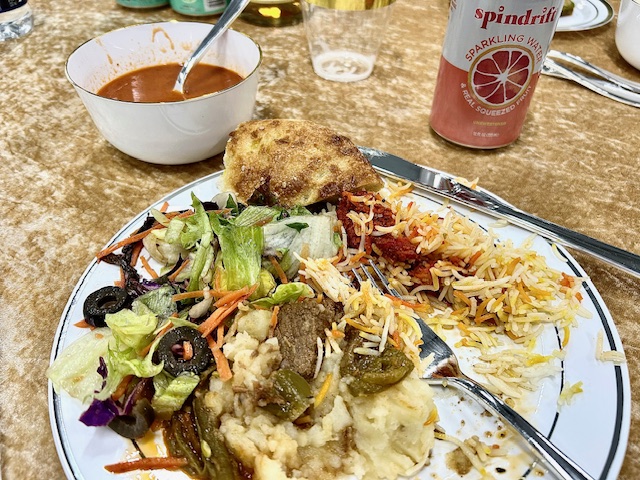
All in all, it was an evening where I was fed with friendship as well as food. Many thanks to the Divan Center for arranging it and to the many interesting people I met who attended it. I wish as a society had more opportunities like this to come together to find unity among diversity.
 blissfullu.com
How wonderful you and Dusty attended!Very proud of us!Sent from my iPhone
LikeLiked by 1 person
Michelle L was there as well. But we all loved our experience. It was a gift to attend ❤️
LikeLike